
One word, four pages: making a short comic about Sugita Genpaku
Armoa / MONOPHASES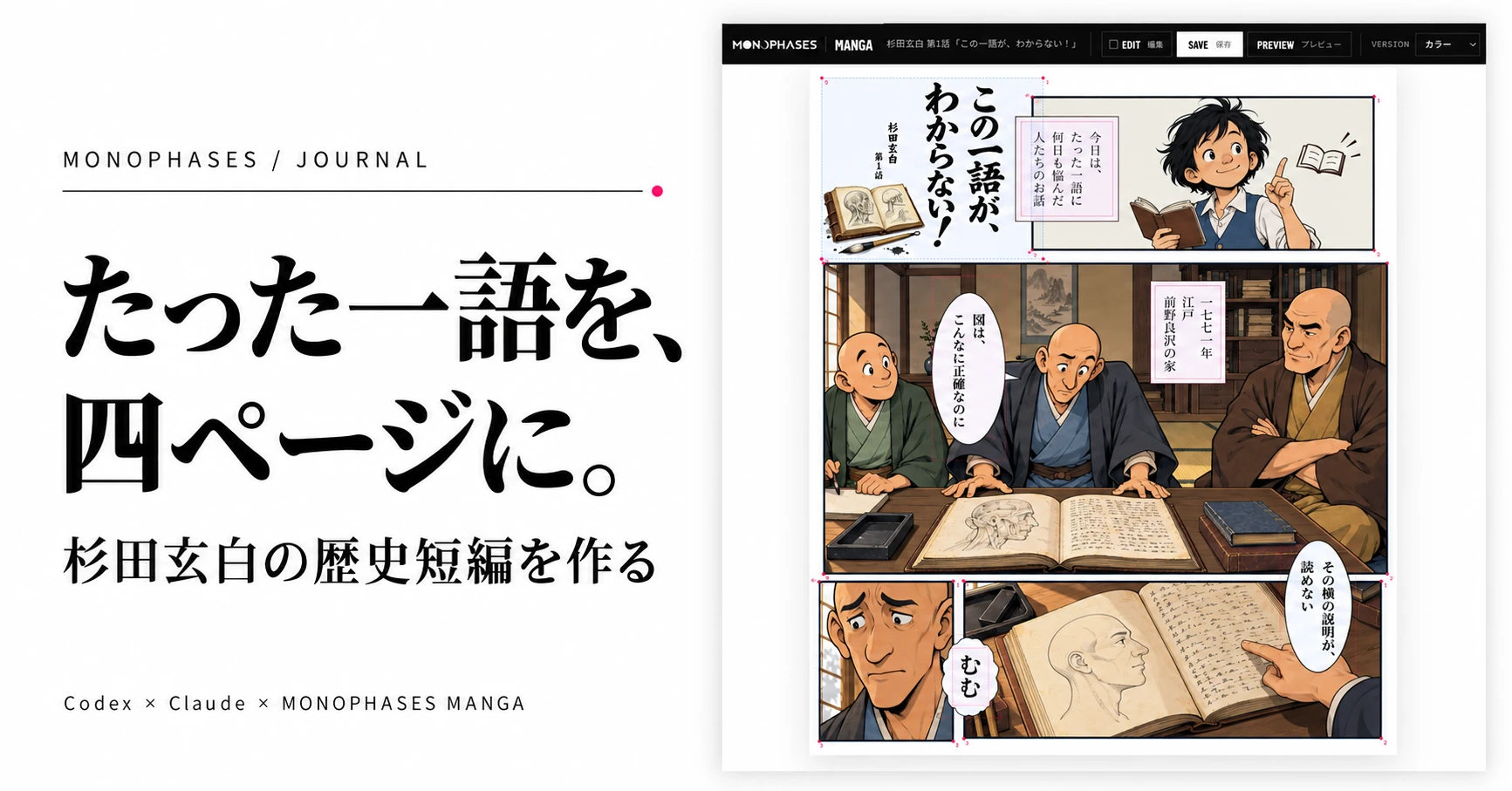
I made a four-page historical comic about Sugita Genpaku and his companions struggling to understand a single word. Episode 1 is titled “I Can’t Understand This One Word!” It was produced in MONOPHASES MANGA with Codex and Claude.
Here is the finished comic: four full-color pages, read from right to left. The comic is in Japanese.
Read Sugita Genpaku Episode 1 (Japanese) ↗
Sugita Genpaku · Episode 1
All four pages below are in Japanese. Open the reader above for a two-page spread on larger screens.
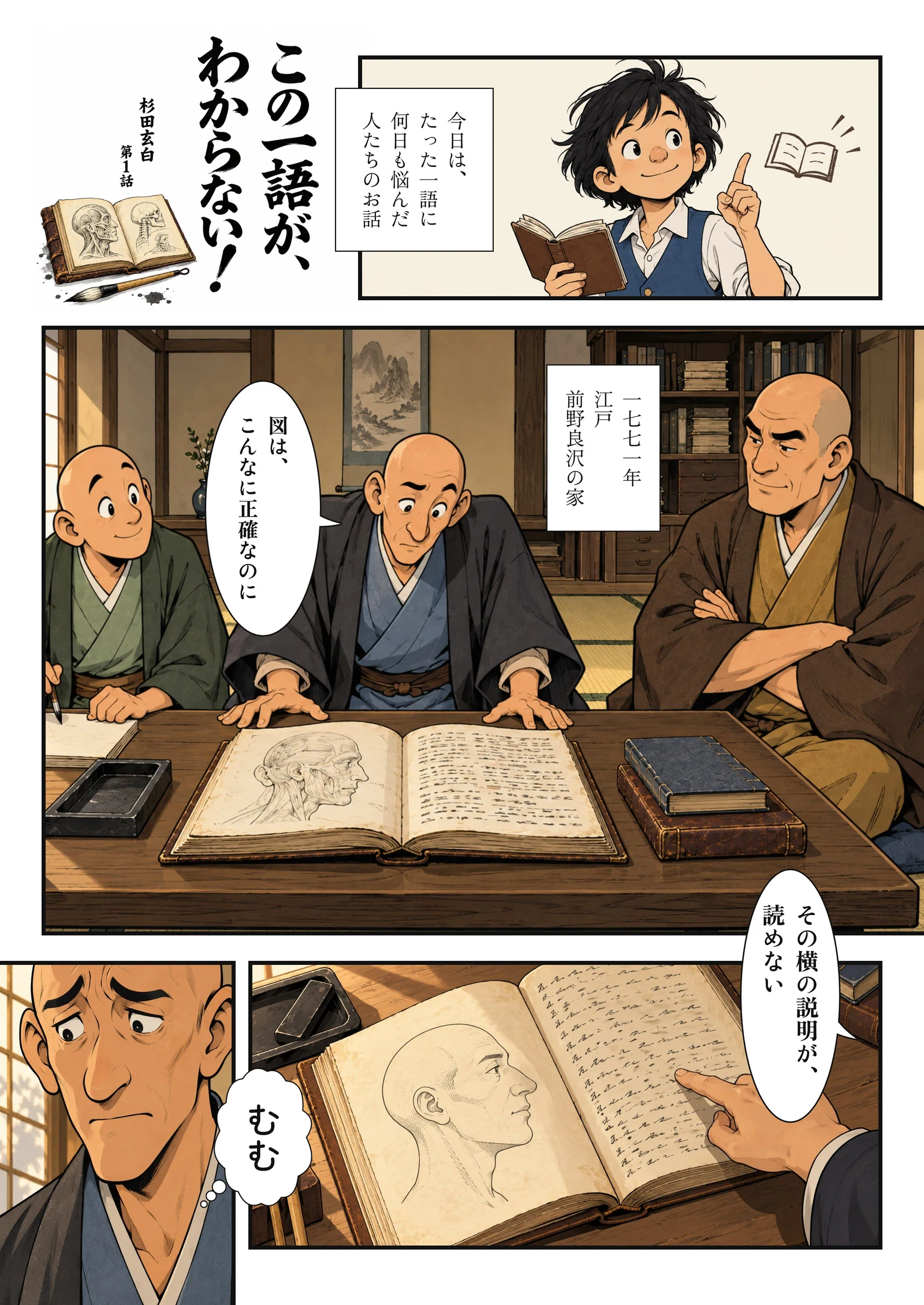
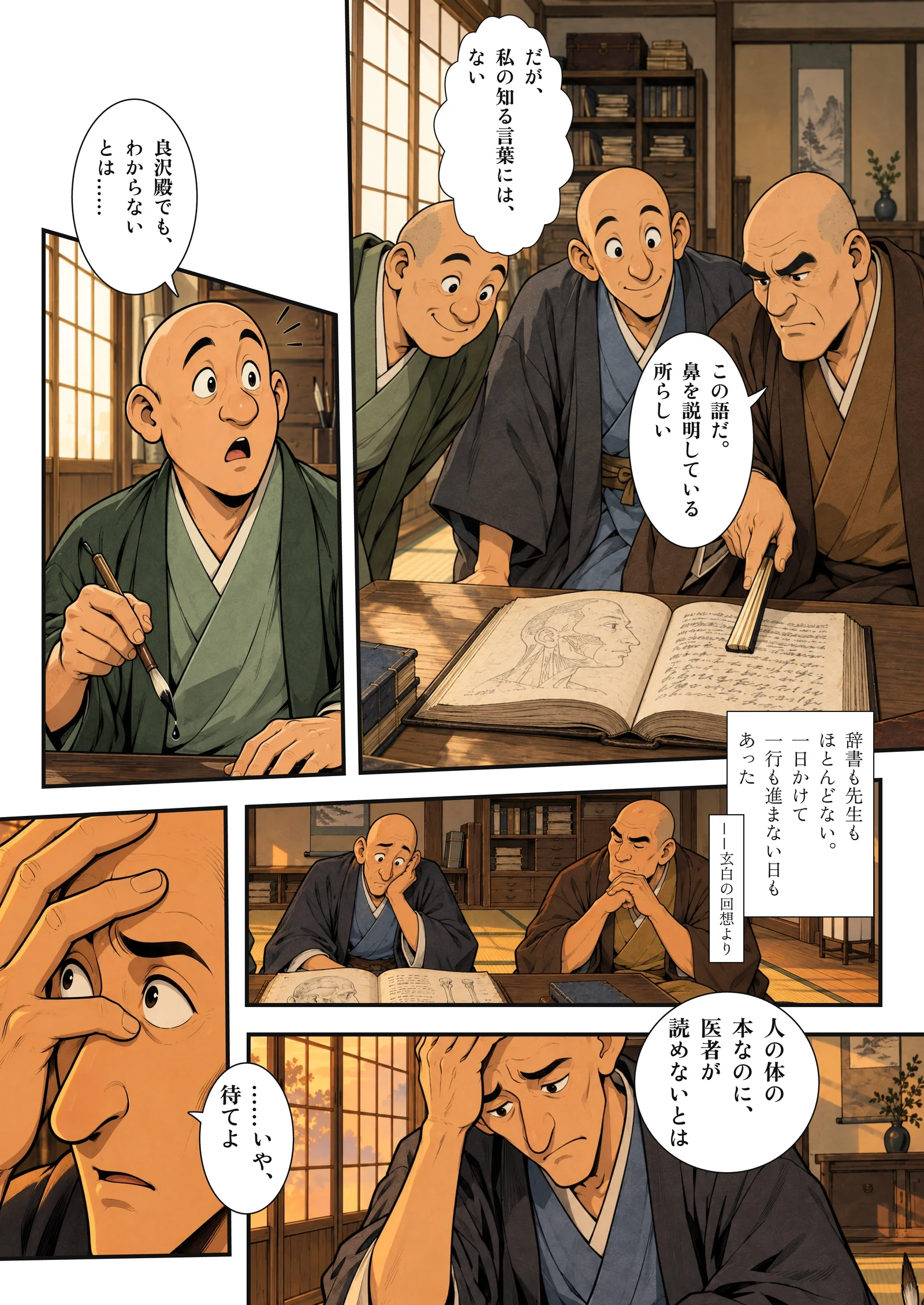
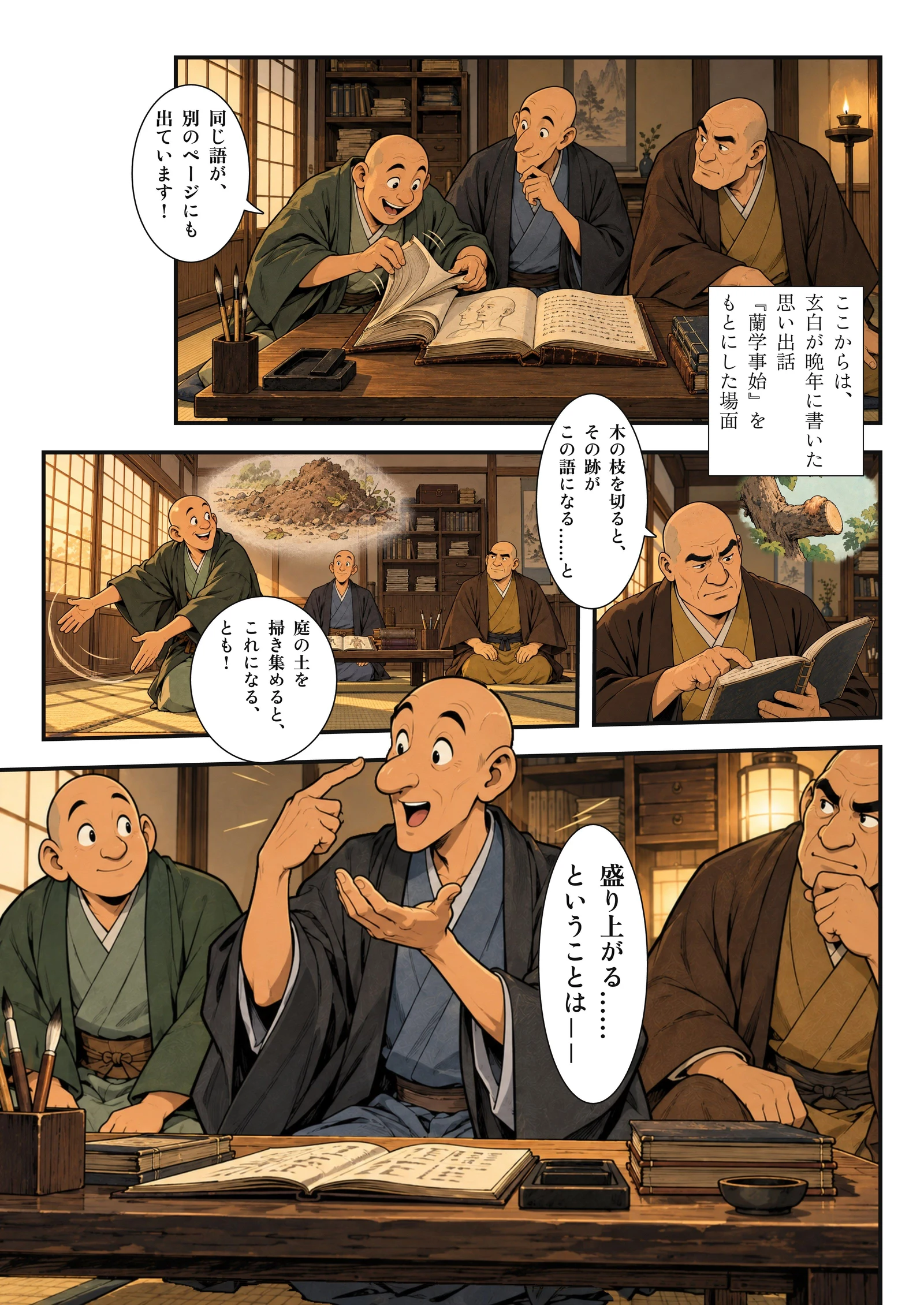
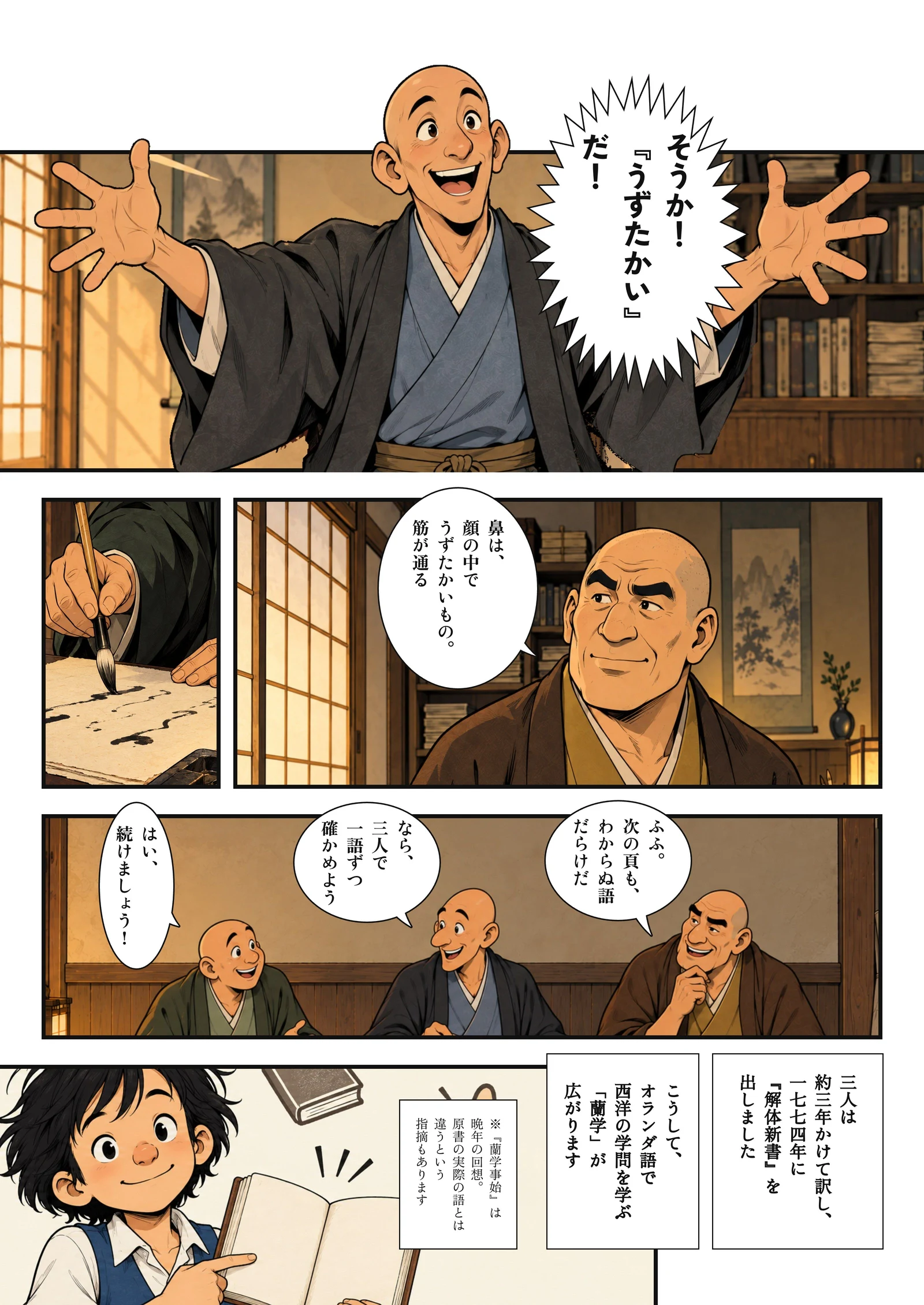
This episode focuses on one immediate problem rather than fitting Genpaku’s entire life into four pages. It introduces the people and their time through the struggle to understand an unfamiliar word rather than a list of achievements.
The setting is Maeno Ryōtaku’s home, where Genpaku, Ryōtaku and Jun’an are translating an anatomical book. They can see the illustrations, but cannot read the explanations. They look for clues in other uses of a word.
Even a small exchange around a desk can show the moment when “I don’t know” becomes “I understand a little.” That change is the heart of this short comic.
Production began with AI organizing the research, separating material grounded in historical sources from details added for the comic before developing the script. Dialogue, expressions and small interactions were created to make the story readable.
The scene draws on Genpaku’s later recollections in Rangaku Kotohajime. The research distinguishes those memories from the wording in the original anatomical book, and the comic ends with a note on that distinction.
The story treats uncertainty as something shared rather than one person’s failure. Each man thinks and contributes clues. Understanding one word leaves unfamiliar words on the next page, and the three continue together.
Codex and Claude handled most of the production. Codex researched and organized reference material and produced character and background references, panel artwork and the title image. Claude developed the script, dialogue and page composition and assembled the initial layout in MONOPHASES MANGA. The initial panel layout did not use bleed or figures extending beyond panel borders, so I advised incorporating those effects. AI handled revisions during production. The only direct changes a human made to the work were the final layout adjustments.
That description sounds like a sequence of handoffs between AI tools. The actual production also involved returning to earlier steps for revisions.
A drawing could work on its own, yet hide a face once dialogue was added. Sometimes the text drew attention before the expression. Moving things was not always enough; the AI also regenerated some artwork.
Comic artwork needs room for words. Choosing a drawing on its own and reading it within a page reveal different problems. Several issues only became clear after assembly.
Even after the four pages were assembled, I adjusted panel sizes, balloon placement, line breaks and lettering in the editor. Who is speaking? Where does the eye move next? How long should the reader look at the drawing between lines? I reread the pages to make those decisions.
At the moment of discovery, a character extends beyond the panel border. In the final layout adjustments, I refined how that moment comes across visually as well as through dialogue.
Liking the artwork does not mean the page is finished. Being able to keep a drawing while refining text and placement helped throughout this production.
Using the editor on real pages also revealed problems with the tools. Adjusting an angled panel could change its shape unexpectedly. A line I wanted to show could disappear. A figure meant to extend beyond a panel could affect the background in an unintended way.
When something went wrong, I could say, “Claude! This part has gone strange! Here’s what I want it to do!” Connected to the app through MCP, Claude could inspect its state behind the scenes, investigate the cause and fix it. I could ask for help with a troublesome spot and have the tool itself repaired. During this production, Claude felt like a dependable companion, a little like Doraemon.
I gave advice on presentation during production, but my direct edits were limited to the final layout stage. Using the artwork and dialogue supplied by AI, I adjusted panel and balloon placement, line breaks and lettering size to refine the reading flow.
Research and final page adjustments took place from October 6 to 7, 2026, over roughly one night. The first output did not become the finished work unchanged. AI revised artwork and corrected tool issues, and a human made the final layout adjustments to finish the four pages.
What remains is the finished comic and observations for the next production. Looking back at what was hard to read and what I wanted to change suggests new ways to present the next story.
I plan to continue with other historical figures and events. A fictional child named Shiori will guide readers through small problems and decisions from history, one episode at a time.
Genpaku and his companions work through unfamiliar words one at a time. I worked through panels that did not read as intended, one at a time. During production, the subject and the process seemed to overlap a little.
For now, four pages. I will take what I learned from finishing this short story into the next episode.